 EN
EN

What Are Prefabricated Steel Components and Why Do They Matter?
Defining prefabricated steel: factory-built, precision-engineered structural elements
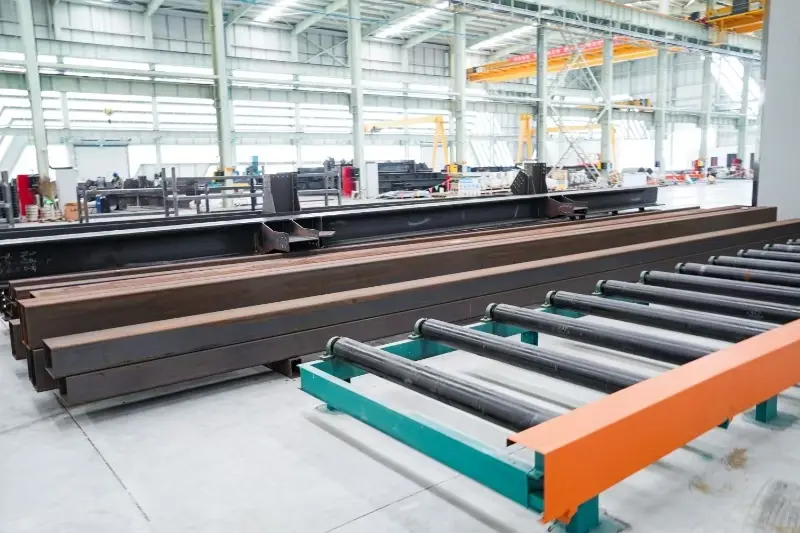
Prefabricated steel components are manufactured in a controlled factory environment using computer-guided cutting, welding, and finishing processes. Each beam, column, truss, or panel is produced to exact dimensional and performance specifications—aligned precisely with the building information model (BIM). This eliminates the variability, weather dependency, and dimensional inconsistencies common in on-site fabrication. The result is a consistent, high-integrity product that arrives ready for rapid, error-resistant assembly. By decoupling manufacturing from site work—allowing factory production to run concurrently with foundation preparation—prefabricated steel compresses project timelines while enhancing structural predictability and quality assurance from day one.
Core applications: beams, columns, trusses, floor systems, and façade-integrated frames
Prefabricated steel serves as the backbone of modern commercial, industrial, and mixed-use construction. Primary beams and columns form load-bearing skeletons for warehouses, logistics hubs, and multi-story buildings. Roof trusses span large open areas without interior supports, optimizing usable space. Floor systems integrate steel decking with joists and composite slabs to deliver stiffness, fire resistance, and speed of installation. Increasingly, steel frames are designed as integral parts of façade assemblies—supporting curtain walls, rainscreens, and insulated cladding panels with precision anchorage and thermal break integration. This breadth of application, combined with standardized connections and repeatable detailing, enables faster procurement, simplified coordination, and consistent structural performance across building types.
How Prefabricated Steel Accelerates Project Timelines
Off-site fabrication enables parallel workflows: site prep + factory production
Prefabricated steel unlocks true concurrency in construction scheduling. While crews prepare foundations, grade sites, and install utilities, the fabricator simultaneously produces and finishes structural components under controlled conditions. This dual-track execution collapses sequential dependencies—eliminating the traditional “wait-for-foundation” bottleneck—and allows structural erection to begin as soon as the substructure is ready. For mid-rise and industrial projects, this parallelism routinely delivers 30–50% schedule compression versus conventional stick-built methods.
Data-backed impact: up to 40% reduction in on-site labor time (McGraw Hill, 2023)
Factory-controlled fabrication achieves 98% schedule adherence—compared to just 63% on conventional job sites—by removing weather delays, material shortages, and rework cycles (Construction Industry Institute, 2023). With fewer trades required on-site and reduced coordination complexity, on-site labor time drops by up to 40%, lowering both direct costs and safety exposure. Faster structural completion also shortens financing periods: for a $5 million project, finishing 10 weeks early saves approximately $77,000 in interest alone.
Real-world validation: 28-day structural erection reduction in Austin mixed-use project
A five-story mixed-use development in Austin used prefabricated steel framing to accelerate delivery. Columns, braced frames, and composite floor panels were fabricated off-site while foundations were poured and cured. Structural erection was completed 28 days ahead of the conventional baseline—enabling mechanical, electrical, and interior trades to mobilize earlier. That acceleration moved the certificate of occupancy forward by over six weeks, improving cash flow and return on investment without compromising design intent or code compliance.
The Strategic Advantages of Prefabricated Steel Beyond Speed
Cost efficiency: lower rework and material waste (15–20% vs. traditional methods, NIST)
Prefabrication minimizes on-site errors, field modifications, and material over-ordering. According to the National Institute of Standards and Technology (NIST), prefabricated steel methods reduce material waste by 15–20% compared to traditional construction—translating directly into cost savings and leaner supply chain management. Fewer change orders, less scrap disposal, and tighter inventory control further strengthen budget discipline. Coupled with steel’s long service life and minimal maintenance requirements, these efficiencies deliver value across the asset’s full lifecycle.
Quality and consistency: CNC precision, controlled environment assembly
Computer Numerical Control (CNC) machinery ensures millimeter-level accuracy in cutting, drilling, and welding—far exceeding what’s achievable in dynamic, weather-affected field conditions. Every component matches its digital twin, enabling bolt-for-bolt fit-up and eliminating tolerance stacking during assembly. This repeatability simplifies QA/QC, accelerates third-party inspections, and reduces punch-list items. Fabricators certified to AISC 360 and AWS D1.1 standards further reinforce confidence in weld integrity, connection reliability, and structural continuity.
Sustainability gains: reduced site disturbance, recyclability, and embodied carbon optimization
Prefabricated steel significantly lowers environmental impact at multiple stages. Off-site production minimizes on-site noise, dust, traffic, and temporary utility demand. Steel remains the world’s most recycled structural material—retaining full strength after infinite reuse—and today’s domestic mills average over 90% recycled content. Moreover, optimized shop fabrication reduces energy-intensive secondary operations and cuts embodied carbon per square foot—especially when paired with low-carbon steel procurement pathways and efficient connection designs. These attributes support LEED v4.1, ILFI Zero Carbon Certification, and other rigorous green building frameworks.
Integrating Prefabricated Steel into Modern Construction Delivery Models
Enabling modular and hybrid construction without compromising structural integrity
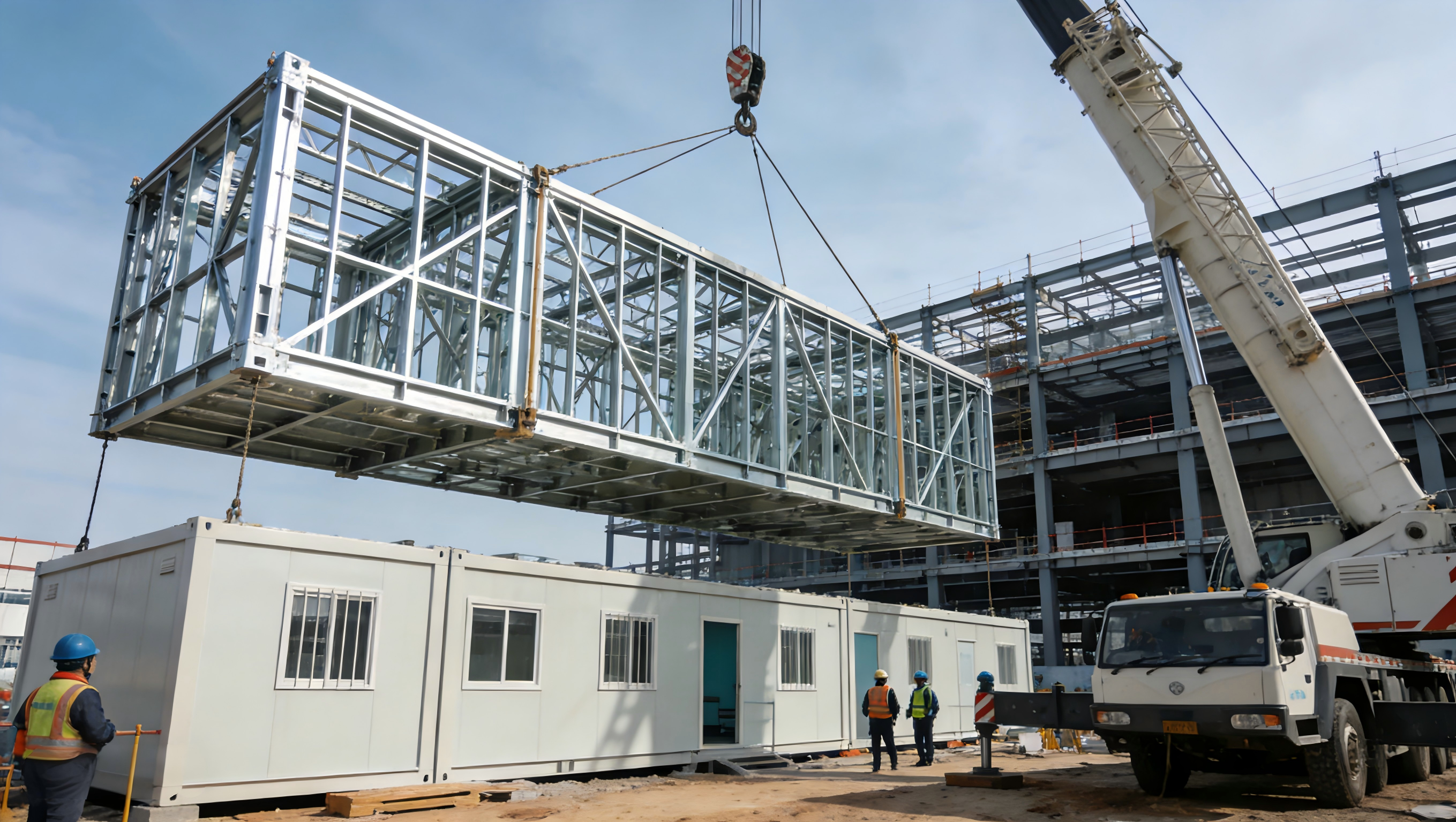
Prefabricated steel is foundational to scalable modular and hybrid delivery strategies. In fully modular builds, steel-framed volumetric units arrive on-site with integrated MEP rough-ins and fire-rated enclosures—ready for crane-and-bolt assembly. In hybrid models, prefabricated steel frames interface seamlessly with cast-in-place concrete cores, mass timber floors, or precast façades. Steel’s high strength-to-weight ratio, dimensional stability, and compatibility with standardized connection details ensure joint performance meets or exceeds conventional design assumptions—validated through rigorous connection testing and finite element analysis.
Design-for-manufacture-and-assembly (DfMA) as the critical success enabler
Design-for-manufacture-and-assembly (DfMA) is the essential methodology that unlocks prefabricated steel’s full potential. It requires early collaboration among architects, structural engineers, fabricators, and contractors to embed manufacturability, transportability, and constructability into the design itself. DfMA standardizes component geometry, consolidates connections, and validates tolerances digitally before any steel is cut—reducing field modification requests by more than 50% and enabling digital twin verification of fit and function. When applied rigorously, DfMA transforms prefabricated steel from a scheduling tactic into a strategic delivery platform—delivering speed, cost control, quality assurance, and sustainability outcomes in alignment with owner objectives.